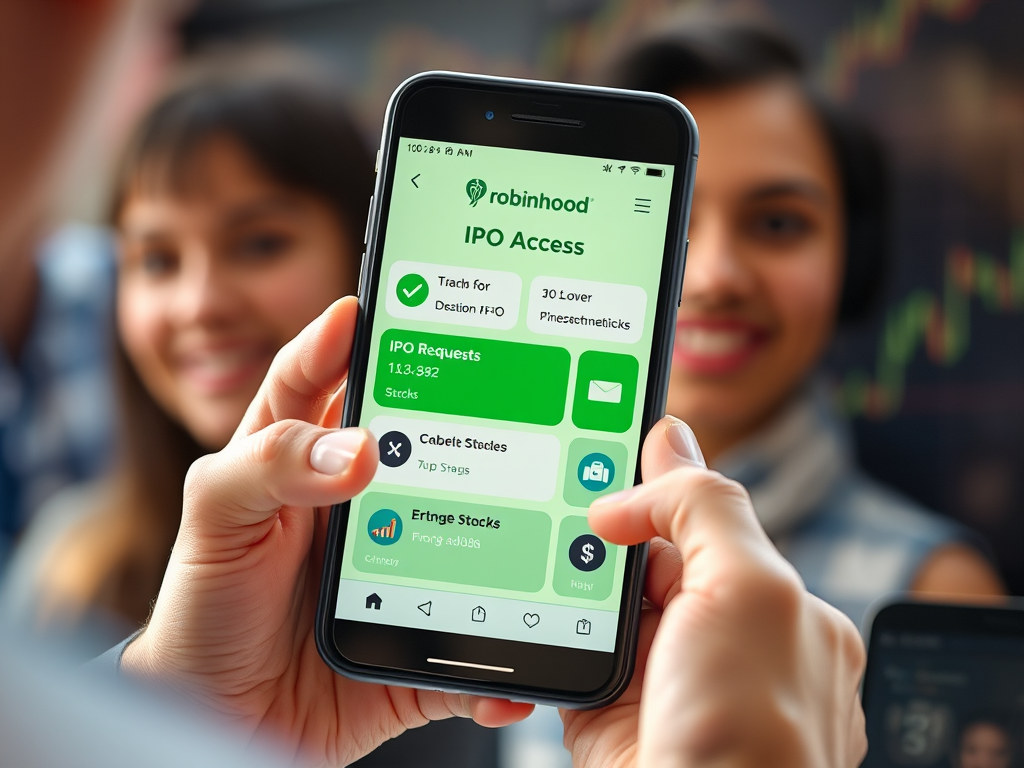
Why this now: Retail investors keep asking why an IPO “request” in Robinhood turns into zero shares—or a tiny fill. Here’s a simple, source-backed explainer of how the feature works, the 30-day flipping rule, and what to do differently next time.
Key takeaways
- Requests are COBs, not orders: A “request” is a Conditional Offer to Buy (COB)—no guarantee you’ll receive any shares.
- Allocation is random: Robinhood says eligible requests go into a pool and shares are randomly allocated; you can get all/some/none.
- Flip within 30 days? You can sell, but it’s counted as a flip and may restrict you from future IPOs for ~60 days.
- Zero-share outcomes are common: Oversubscription, eligibility checks, timing windows, or buying power issues can all leave you with 0.
- DSP is separate: Directed Share Programs (DSPs) are issuer-run set-asides for employees/customers; they’re outside the broker’s random pool.
The basics: requests, timing, and where the decision happens
Inside the app, you request IPO shares. That request is a COB—you’re signaling interest to buy at the IPO price range, but nothing is locked in. After the final price is set, there’s usually a short window to review, edit, or cancel before allocation.
Think of it like joining a lottery line, not placing a market order. The underwriters decide how many shares go to Robinhood, and then Robinhood allocates within its own customer pool.
Jargon buster
COB (Conditional Offer to Buy): A request to buy IPO shares at the offering price; it isn’t a guaranteed order.
Allocation: The process of distributing limited IPO shares to investors.
Flip: Selling IPO shares within 30 days of listing—allowed, but can trigger a future access restriction.
DSP: “Directed Share Program,” where issuers reserve shares for a specific group (e.g., employees).
Allocation method & the flipping rule (the part people miss)
Allocation: Robinhood states it uses a random selection model among eligible requests. Everyone in that pool has the same chance of receiving shares, independent of account size or request size. In hot deals, most people will still get nothing simply because demand dwarfs supply.
Flipping rule: If you sell within 30 days, Robinhood marks it as a flip. It won’t block the sale—you’re free to trade—but you may be restricted from participating in upcoming IPOs for roughly 60 days. The idea is to discourage quick flips that can irritate issuers and underwriters.
So what: Treat IPO Access as optionality, not certainty. If you get an allocation, decide upfront whether you’re investing or trading—because flipping can cost you future access.
Why you might get 0 shares (even when you did everything “right”)
Here are common, legitimate reasons:
- Oversubscription math: There just aren’t enough shares. Random allocation plus small broker allotments often produce many zero outcomes.
- Eligibility checks: Some accounts can be ineligible for a given offering due to regulatory or issuer criteria (e.g., new-issue rules or issuer restrictions).
- Timing windows: If you cancel, don’t confirm after pricing, or miss a cutoff, your request won’t be in the final pool.
- Buying power at allocation: You typically need enough available cash when allocation happens; otherwise your request can’t be filled.
- Issuer choices: Not every IPO routes shares to every broker; sometimes Robinhood simply doesn’t receive many shares.
Quick guardrails: Keep enough cash ready before pricing, watch in-app notifications closely, and understand that “all/some/none” is normal, not a glitch.
DSPs: what they are, and how they differ from IPO Access
A Directed Share Program is run by the issuer, not the broker. Companies may set aside a slice of the deal for employees, customers, or partners at the IPO price. If you’re invited, you’ll generally follow a separate flow (often via a link), and you may need to confirm buying power and complete extra steps.
Key difference: DSPs aren’t part of Robinhood’s random pool. They’re parallel, invitation-only channels. If you have potential eligibility (employee, customer), check company communications early.
Bottom line
IPO Access on Robinhood is a fair randomized system layered on top of tight supply. A request is a COB, not a promise; many deals will leave you with 0 shares. If you do get an allocation, flipping within 30 days can limit future access.
One practical next step: For any must-own IPO, line up multiple routes—Robinhood request, check for a DSP invite, and consider a plan to buy in the open market if you don’t get an allocation.
Sources
- Robinhood Support – About IPO Access (COB; random allocation; all/some/none). Robinhood+1
- Robinhood Support – How to request IPO shares (COB inside the app). Robinhood
- Robinhood Support – How to sign up for IPO Access (flipping within 30 days → ~60-day restriction). Robinhood
- Reuters – Robinhood to restrict users who ‘flip’ IPO shares (context on 60-day access penalty). Reuters
- Robinhood Support – Why didn’t I get the requested IPO shares? (common zero-allocation reasons). Robinhood+1
- Robinhood Support – What’s a Directed Share Program? (DSP basics); plus FINRA Rule 5131 (new-issue allocation rules). RobinhoodFINRA


Leave a Reply